HOMOPHOBIA IN FOOTBALL

FOOTBALL VS THE WEB

Listen to
the episode

Listen to the accompanying short audio episode, where Kyle discusses Justin Fashanu's career before coming out as gay in 1990.

Football,
Identity &
Homophobia

INTRODUCTION.

Football has always been described as a game for everyone. Yet for LGBTQ+ supporters, players and staff, football spaces can still feel anything but welcoming.

Homophobic language has become so normalised within parts of football culture that abuse is often dismissed as "banter", even when the people targeted experience it as intimidation, exclusion or hatred.

The problem does not exist only inside stadiums. It can appear in grassroots football, professional games, dressing rooms, social media and online communities surrounding the sport.

And while more people are now willing to report discrimination, the numbers show that homophobia remains deeply embedded within the culture of football.

Football stadium

THE STATS
AND FIGURES

KICK IT OUT & FOOTBALL VS HOMOPHOBIA.

In a study condicted by Kick It Out, it was reported that there had been a 46% increase in reports of homophobia and discriminatory mass chanting. Lou Englefield, the Football v Homophobia director said that the organisation notes a 25% increase of all forms of discrimination from the previous season (Football v Homophobia and Kick It Out, 2026).

During the 2025/26 season, the 46% increase equates to 203 reports of homophobia, up from 139 in 2024/25. Reports involving discriminatory abuse towards officials also rose as well as a 90% increase in reports of homophobia within youth football.

Football v Homophobia also highlights that reports of homophobic and transphobic mass chanting during 2025/26 matched the total recorded across the previous four seasons combined.

Despite the majority of the statistics covering offenses taking place at games, Football v Homophobia showcased that there was a 73% increase in online hate crime abuse incidents linked to football (Football v Homophobia and Kick It Out).

The numbers
tell a story

Kick It Out recorded 203 reports of homophobia during the 2025/26 season — a 46% increase on the previous campaign. The figures below compare the latest two seasons referenced by the reporting data as well as additional information from research provided on additional Kick It Out pages.

Interactive data SELECT A SEASON →
24/25
SEASON
139
REPORTS
→
25/26
SEASON
203
REPORTS
→
2025/26 SEASON
203
Homophobia reports
Reports of homophobia recorded by Kick It Out across professional football, grassroots football and online spaces.
↑ 46% YEAR-ON-YEAR
THE JOURNEY
REPORTS OVER TIME
YOUTH FOOTBALL
90%
Increase in reported incidents during the 2025/26 season.
HOMOPHOBIA
+46%
Year-on-year increase in reported homophobia.
Where reports came from
2025/26
1,744 TOTAL REPORTS
Types of discrimination
2025/26
KICK IT OUT REPORTS
Discriminatory mass chanting
142 ↑41%
Reports of discriminatory mass chanting reached the highest number recorded by Kick It Out.
Abuse towards officials
97
Discriminatory reports involving abuse towards officials matched the same level as the previous three seasons combined.
U18 football
248 ↑⅓
Reports involving U18 football increased for a fifth consecutive season and reached a record level.
SOURCE: KICK IT OUT 2025/26 REPORTING STATISTICS. REPORTS ARE A SNAPSHOT OF DISCRIMINATION REPORTED TO KICK IT OUT, NOT A COUNT OF EVERY INCIDENT ACROSS FOOTBALL.
SOURCE: KICK IT OUT / FOOTBALL V HOMOPHOBIA — 2025/26 REPORTING DATA

WHAT DO THE NUMBERS TELL US?

The 46% rise in reports of homophobia represents an increase in incidents reported to Kick It Out rather than there typically being 'more incidents of homophobia.' Whilst the statistics make for bad further-reading it can be spun for a more positive one. The increase in reported incidents imply that individuals facing abuse now know where to report the behaviour and are more comfortable challenging the abuse.

Football v Homophobia also highlights that reports of homophobia in youth football increased by 90% compared with 2024/25. Despite the point made above, these figures highlight that the behaviour of those committing the abuse starts from a young age, becoming a second nature rather than behaviour picked up later in life. This could be as a result of home life, other social environments as well as battling coming to terms with their own sexuality.

Football supporter

A FAN'S
EXPERIENCE

SUZY STEPHEN

"It's difficult because sometimes people can feel alone."

ABOUT SUZY.

Suzy Stephen is a Girls Scholarship coach and Girls Development Pathway Co-ordinator at Peterborough United Foundation. She started playing football at 10-years-old however developed a strong understanding behind the game.

She said: ''I carried on playing from ages 10-16 then my team folded. Then my sister got involved in football so I decided to start a team at my existing club for her.''

Over the course of their early career, Suzy has coached in a voluntary role at Lincoln City before being offered a job at 17. Now, she's moved across to becoming Sleaford Town Women's Manager and for the under-14's, as well as also being a part-time coach developer for England FA.

Growing up, Suzy would have experienced forms of homophobic abuse, however womens football acts as a safe space. According to reports, there was an estimated 96 individuals openly LGBTQ+ at the 2023 World Cup. This equated to roughly 13% of the entire competition. Compared to the mens game, the difference is clear to see. In mens' professional football there are supposedly only 5 high-profile mens players who openly identify as part of the LGBTQ+ community.

''Football culture isn't great when it comes to anyone being different. In the mens game it's clear with how many male players are fully out about their sexuality. The women's game is different, I think it's seen as more of a family game. It's a nicer play than men's football to be LGBTQ+,'' said Suzy.

''Masculine lesbian stereotypes are the most harmful to women in football however. If you're gay and involved in football people assume this 'butch' character. Sometimes it makes you as a aleokan question: are you being too feminine for that character or too masculine for a woman, it puts a thought in the back of a lot of peoples head.''

In her experiences of observing the media coverage of LGBTQ+ individuals, she highlighted the sensationlism around a player coming out and instead believes there's a lack of real-life stories with personal experiences of coming out to loved ones as well as the broader public. In a journal written by Ting Yu Joanne Chow, Wenshu Yang and Reuben Ng, they imply that despite coverage surrounding the topic increasing over the last decade, the term 'Lesbian' connotates to 'sensationalised cinema, Gay to hate crimes, Bisexual about population surverys and Trans about challenges in transitioning as well as suicide.' (Chow, Yang, Reuben, 2024)

When asked what responsibilities media organisations and supporters each have in tackling homophobia, Suzy said: ''The media should challenge more by giving people a voice, not making assumptions on how peoples lives are affected from being LGBTQ+. Just avoid putting everyday things in headlines that are just peoples lives.''

Women's football has shown to be a welcoming environment for the LGBTQ+ community - contrary to the mens game - where homophobic chanting and abuse online continue to plague the game. Whilst coverage across football media has increased, there is a severe lack of personal experiences being covered which can directly lead to an increase in discrimination. As Suzy mentioned, a male athlete coming out shouldn't be front page, the same way someone might say an athlete announcing his new girlfriend shouldn't be worthy of front page news - which for the most part, it never does make the front page. What is front page worthy however, is those traumatic experiences faced because of sexuality, how family took it, any obstacles they had to face and persevere. More of those stories being published may help the wider public understand.

The conversation
cannot stop here

WHERE DOES FOOTBALL GO FROM HERE?

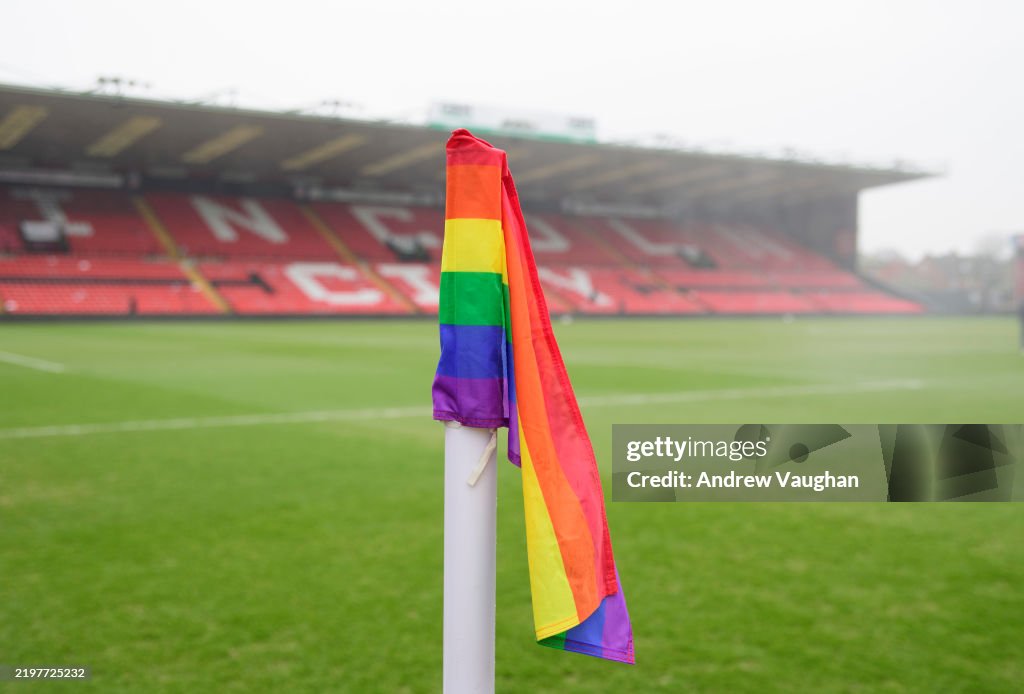
Tackling homophobia cannot be limited to annual campaigns or rainbow-coloured social media graphics. The issue requires action throughout football, from the professional game all the way to grassroots.

Clubs need to make it clear that discriminatory language is unacceptable and whilst more incidents are being reported, supporters need to be made sure that reporting incidents remains stress free and safe.

There is also a wider cultural question. Football has spent decades challenging racism and other forms of discrimination, but homophobic language has often been treated differently — dismissed as part of the atmosphere rather than recognised as discrimination. Instead of passing it off as a joke, treat it for what it is, discriminatory abuse.

If football genuinely wants to be a game for everyone, LGBTQ+ supporters should not have to choose between supporting only one genders football team. Fans of football should be free and feel safe being a part of mathcdays across both the womens and mens matches.

THE FUTURE
OF FOOTBALL
DEPENDS ON
EVERYONE
FEELING
WELCOME